
afıd
The financial fabric of every U.S. commercial airport
Airport finance,
finally in one place.
Every U.S. commercial airport publishes its finances, in a thousand different PDFs, on a thousand different websites, in a hundred different formats. AFID reads them all so you don't have to.
Rates & Charges
Signatory landing fees, terminal rents by space type, and every itemized fee line, normalized to one taxonomy from each airport's own published schedule.
What is inside →Audited Financials
Revenue composition, cost per enplanement, debt and liquidity from audited statements, with every figure tagged with its reporting scope and fiscal year.
What is inside →Agreements & Debt
Rate methodology, terms, and revenue sharing read from executed agreements and bond disclosures, so comparisons are methodology-matched, never apples to oranges.
What is inside →
Our figures trace back to a page in a real document you can see
No estimates. No modeled fill-ins. No paid placement. If an airport has not published a number, AFID says so and tells you why.
AFID cited on the airline cost per enplaned passenger forecast carried in the Metropolitan Washington Airports Authority's own bond documents, which run to $20.71 by 2030 on the capital program approved before the $22.5 billion expansion was announced. Subscription required.
See exactly what
you are licensing.
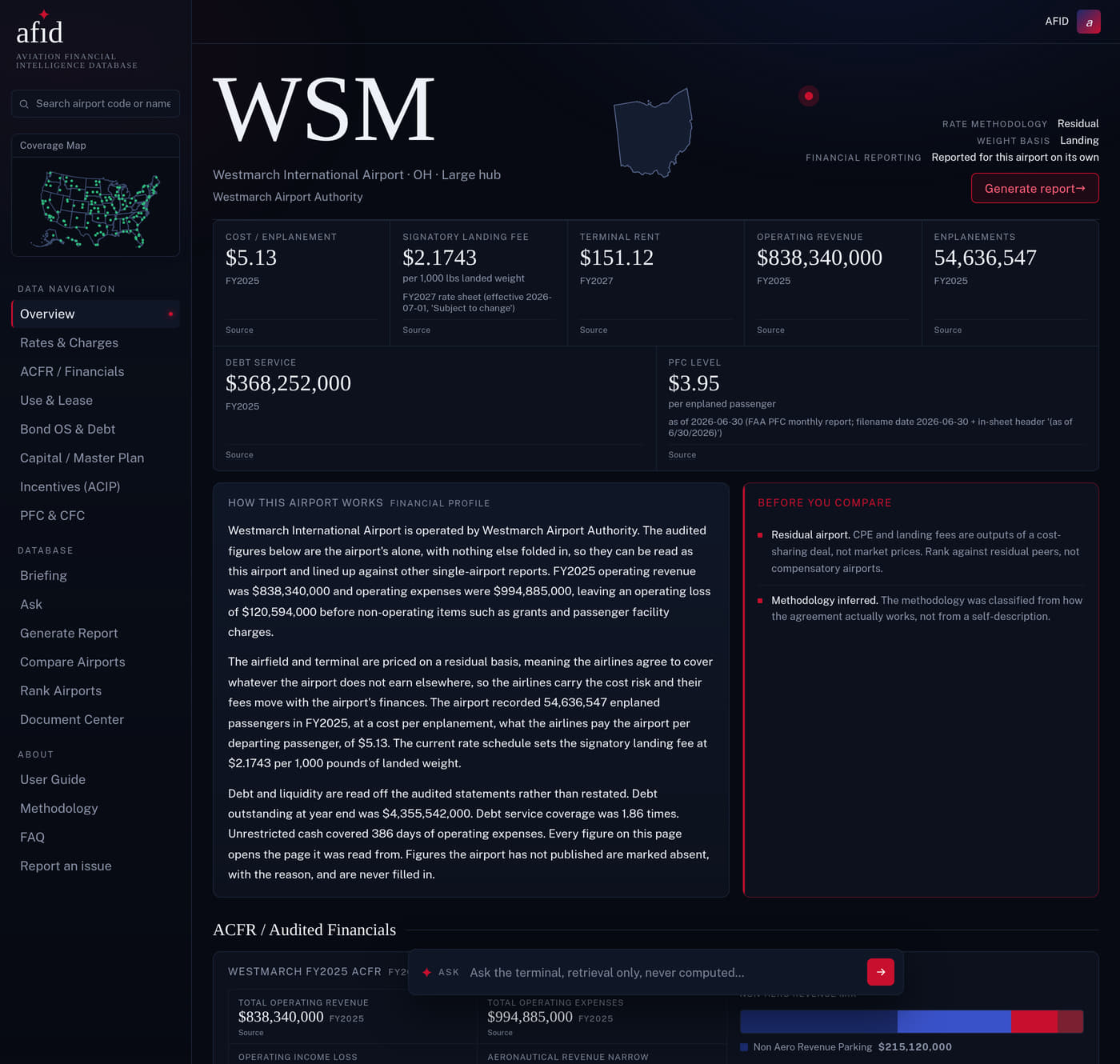
A working financial terminal, not a slide deck. Profiles, screening, side-by-side comparison, and the citation trail behind every single figure.
Built for the people
who read airport finances.
One corpus, three seats at the table.
Screen airports by CPE, coverage, cushion, and methodology. Track use-agreement expirations and document refreshes. Cite the page, not the vibe.
Read more →See your rates, costs, and revenue mix against peers that actually share your deal structure. Benchmarking as a reasonableness check, done properly.
Read more →Walk into an engagement with the airport's financial profile, agreements, and peer context already assembled. The first weeks of document work, done and cited.
Read more →See our data for yourself
Airline use agreements are not on a form you can scrape. They are contracts somebody has to read. AFID read them, and put two of the fields on the open web: when each airport's airline agreement expires, and how each airport actually sets its rates. Every row names the source document, and 104 of the 114 rows carry the exact page.
See more of the platform
Every screen below is the real AFID product running on example data for Westmarch (WSM), a made-up airport. Click any screen to see it full size.
Example data · made-up airport